
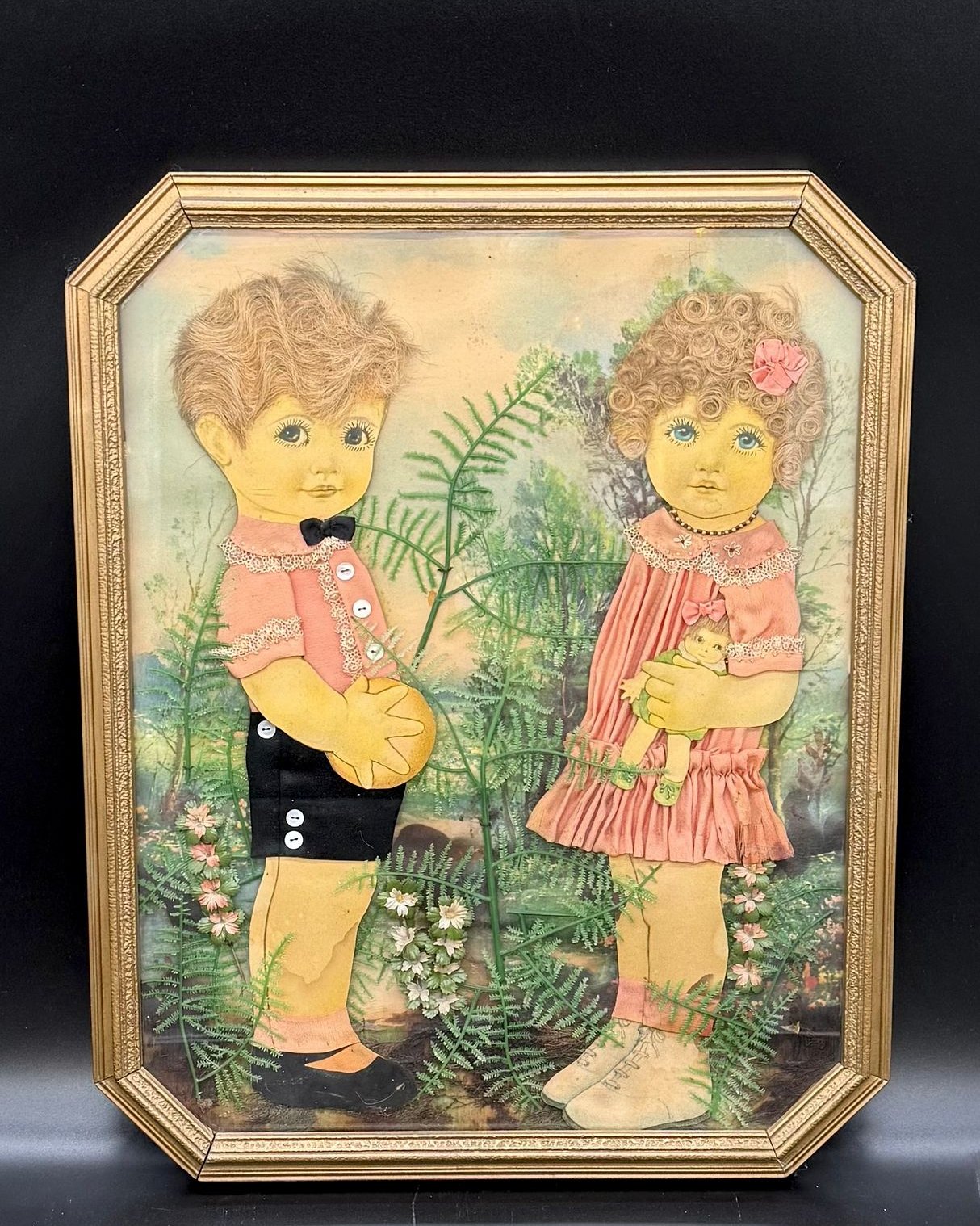
Look closely at the boy’s hair. It is real, and so are the ferns. This is a relief picture, a handmade artwork built up off the surface instead of painted flat onto it. The faces are painted, the clothes are cut and gathered from real fabric, and the woodland the children stand in is made of ferns and flowers somebody pressed, dried, and laid down one at a time. Sixteen by twenty inches of extraordinary patience.
The clothing puts it right where you would expect, 1920 to 1930. She wears a drop-waist dress with a pleated skirt and a lace collar, the silhouette that defined the decade. He is in short pants, a bow tie, and a lace-trimmed jacket fastened with mother-of-pearl buttons no bigger than a fingernail. Somebody sewed every one of those on by hand.
The details keep going once you start looking. She has a beaded necklace and a ribbon rosette pinned in her ringlets, and she is holding a doll, a doll inside a picture, with its own painted face and little green shoes. He is holding a ball. Their hair is applied in real strands, his tousled and hers wound into tight curls, and that is what gives both children their startling out-of-the-frame presence.
It sits in an octagonal gilt frame, canted at the corners, an embossed pattern running the inner edge, under glass that has been protecting all that fragile dried greenery for roughly a century. The background landscape has mellowed to soft golds and greens. That warmth is age, and it suits the piece.
Work like this was made to hang in a parlor or a child’s room, and it still wants that job. A nursery, a hallway with good light but no direct sun, a wall where people will stop and lean in. Because they will.
Come see it in person at Pollyanna’s Antiques in downtown Mt. Clemens, open Wednesday, Friday, and Saturday from 10 to 4. Photographs flatten this one; it deserves the trip.