
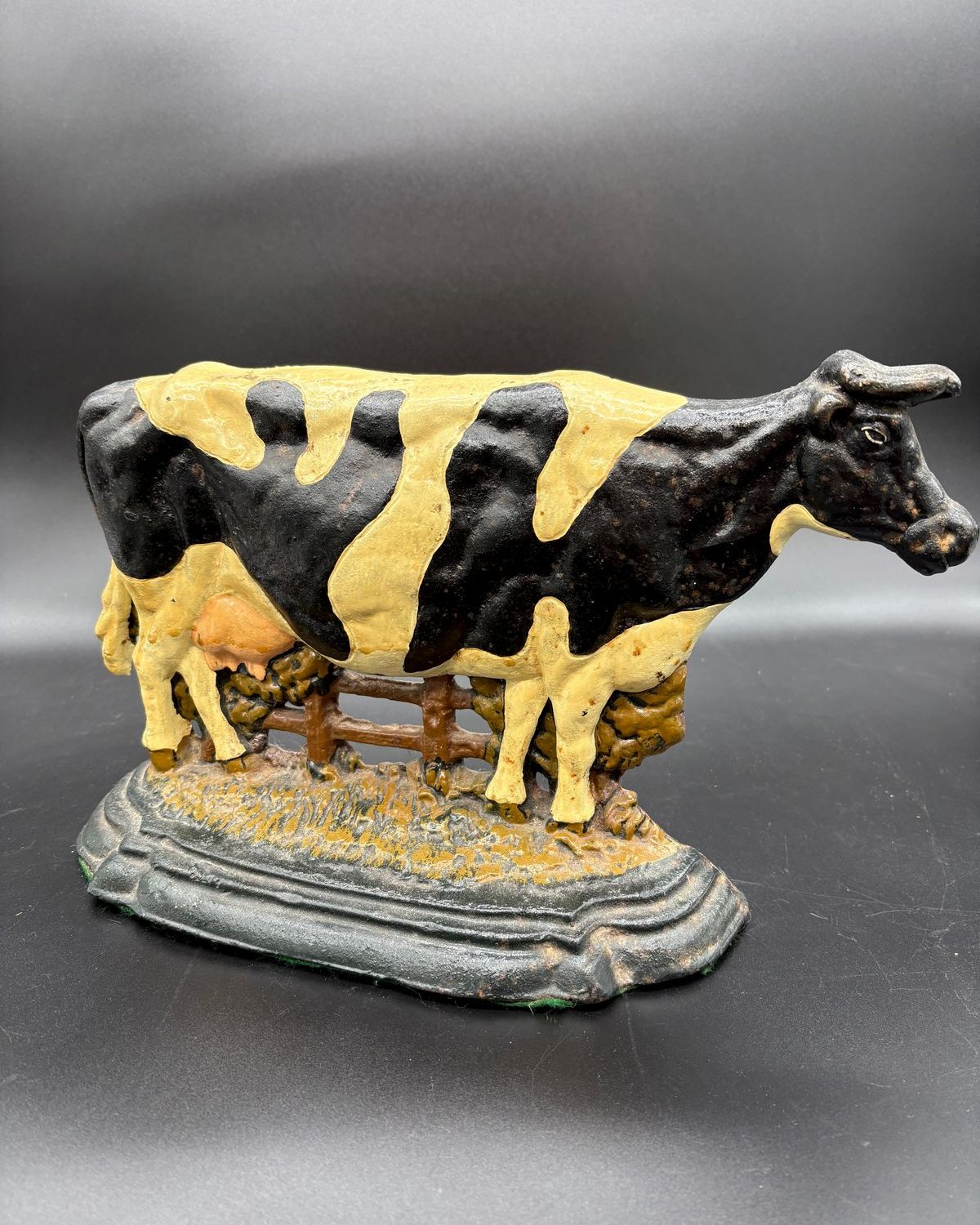
She weighs what a doorstop ought to weigh. Fourteen inches of cast iron cow, black and butter cream, standing at a little brown fence with her head turned toward whoever is coming up the walk. Somebody painted her by hand a long time ago, and somebody else glued green felt to the bottom of her base so she would never scuff a floor. That is two generations of care sitting on one object.
Cast iron figural doorstops had their great run in American houses from the 1890s into the 1940s, back when doors were solid, houses were drafty, and a heavy little sculpture was the cheerful answer to both. Foundries poured them by the thousand, and the painting was done by hand, one piece at a time, which is why no two survivors ever look quite alike.
The modeling on this one is better than it needed to be. Her markings are laid on in soft cream over black, the rail fence and the tufts of grass and shrubbery are cast right into the piece behind her legs, and the oval plinth she stands on has a stepped, molded edge like a scrap of architecture. She has an eye, a proper set of horns, and yes, an udder. Whoever cut this pattern had actually looked at a cow.
She wears her age honestly. There is paint loss across her back and a freckling of rust coming up through the black, and on a piece like this it reads as history rather than damage. Eight and a half inches tall and fourteen inches long, she has the low, planted stance that makes a doorstop work, and she is heavy enough to hold a real door on a real windy day.
Set her at a kitchen door, on a hearth, at the end of a bookshelf, or in an entry where everyone who walks past will want to touch her. Come meet her in person at Pollyanna’s Antiques in downtown Mt. Clemens, open Wednesday, Friday, and Saturday from 10 to 4.