
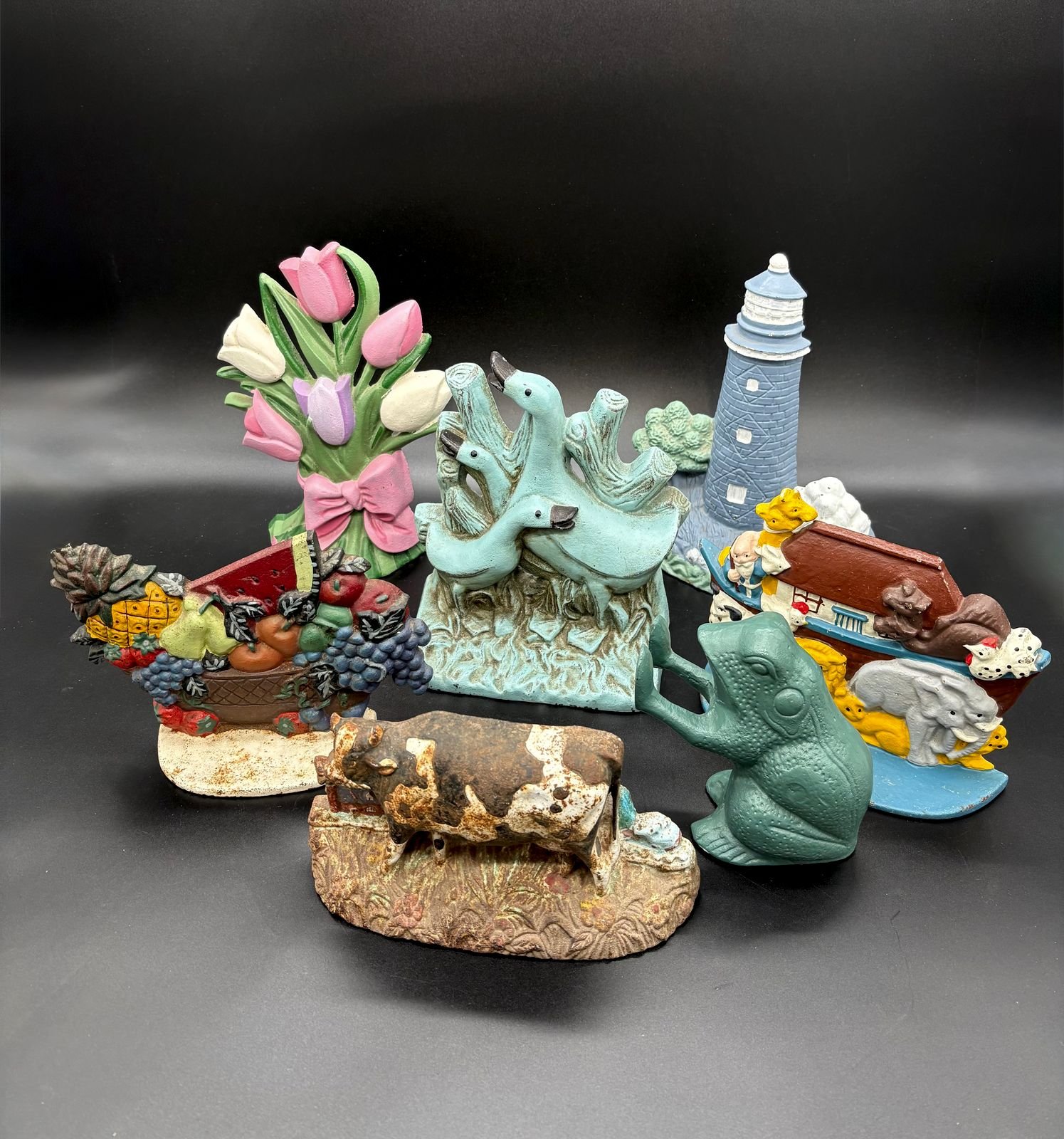
Seven of them came out of the case at once, and the shop got noticeably heavier. A bouquet of tulips tied with a pink ribbon. Three geese at a stump. A lighthouse, a frog, a Noah’s Ark with the animals already boarded, a basket of fruit spilling grapes over the edge, and a hand-painted cow who has been holding doors open since long before any of us. All cast iron. All doorstops.
Cast iron figural doorstops had their long American run from the 1890s into the 1940s, when doors were solid and houses were drafty and a heavy little sculpture was the cheerful answer to both. Subject matter was wide open. Flowers, ships, animals, storybook scenes, whatever a pattern maker thought would look right in somebody’s front hall. That is why a group like this never reads as a set. Each one was somebody’s separate good idea.
Every one of them was painted by hand. The tulips are crisp, pinks and creams with a lavender at the center and the ribbon done in soft rose. The geese wear a chalky aqua that has worn back at the beaks. The lighthouse still keeps its white window squares. The Noah’s Ark is fully staffed, elephants and giraffes and a pair of ducks along the rail, all of it riding a bright blue base.
The cow is the eldest of the group and looks it, rust coming up through her markings and her oval base worn smooth. Set against six brighter neighbors, she is the one people reach for first. Old paint means the piece was used, and a doorstop that was used is a doorstop that did its job.
They all still work. Cast iron has no opinion about a modern door, and one of these at a bedroom door on a breezy afternoon does exactly what it did in 1930. Come look them over at Pollyanna’s Antiques in downtown Mt. Clemens, open Wednesday, Friday, and Saturday from 10 to 4.