
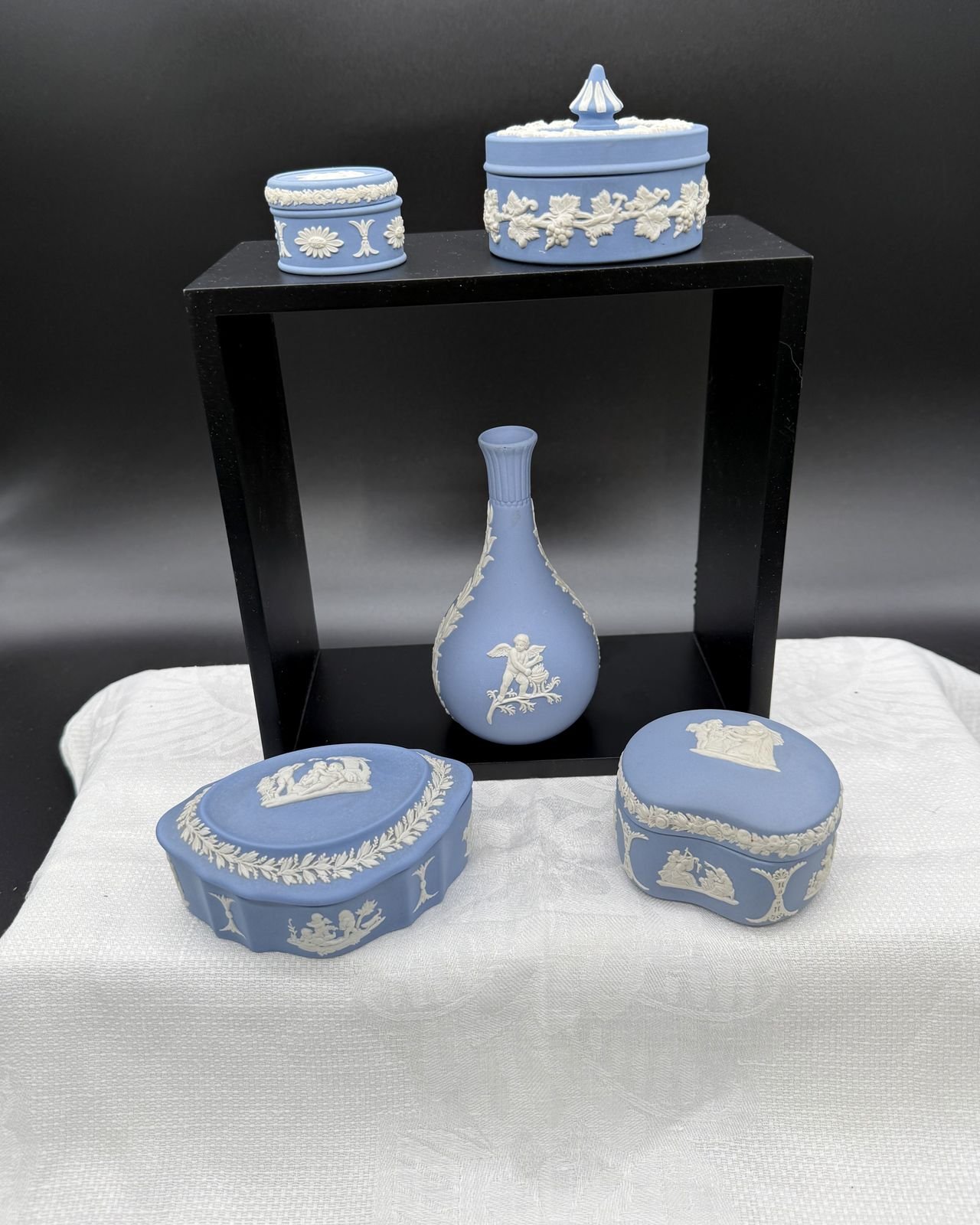
Run a thumb across any one of these and you can feel the picture. The white figures are not printed on and they are not painted on. They are separate pieces of clay, pressed out of a mould and laid onto the blue one at a time by hand, and they stand far enough off the surface to catch a shadow. Five pieces of Wedgwood have come into the shop, and every one of them is finished that way.
The technique is called sprigging, and it is most of what makes this ware hard to do. White clay gets pressed into a plaster mould, lifted out as a thin relief, and set onto a damp blue body with a little slip behind it. Then the whole thing goes into the kiln, where the two clays have to shrink at the same rate or the figures crack away from the ground. Getting them to agree was the problem, and it took Josiah Wedgwood thousands of experiments to solve.
He kept score. Every trial piece came out of the kiln with a number on it, and every number pointed to a line in an experiment book he wrote in his own cipher, because the recipe was worth stealing and he knew it. He had opened his Etruria works in Staffordshire in 1769, and by the middle of the 1770s the new stoneware was ready. The blue is not a glaze sitting on top of it; the colour is in the clay itself. In 1775 he took on a twenty-year-old modeller named John Flaxman, who spent the next twelve years supplying the classical figures the ware is still known for.
What is on the table now is five pieces in the pale blue. A bud vase stands in the middle, pear-shaped with a narrow fluted neck, a winged cupid on its face and leafy swags climbing both shoulders. Above it are two lidded boxes: a small drum banded with daisy rosettes, and a rounder one wrapped in grapevine, grape clusters and vine leaves both, with a white finial on the lid. In front sit two more, a scalloped oval whose lid holds a pair of reclining figures inside a laurel wreath, and a kidney-shaped box ringed with a rose garland.
The boxes were made for a dressing table and they still do that job better than anything sold for it now: rings, cufflinks, collar stays, the earring whose mate turns up a month later. The vase takes exactly one stem, which is the honest number for most of what a garden hands you at a time.
Come and see them at Pollyanna’s Antiques in downtown Mt. Clemens. We are open Wednesday, Friday, and Saturday from 10 to 4, and the reliefs are worth a look from six inches away.