
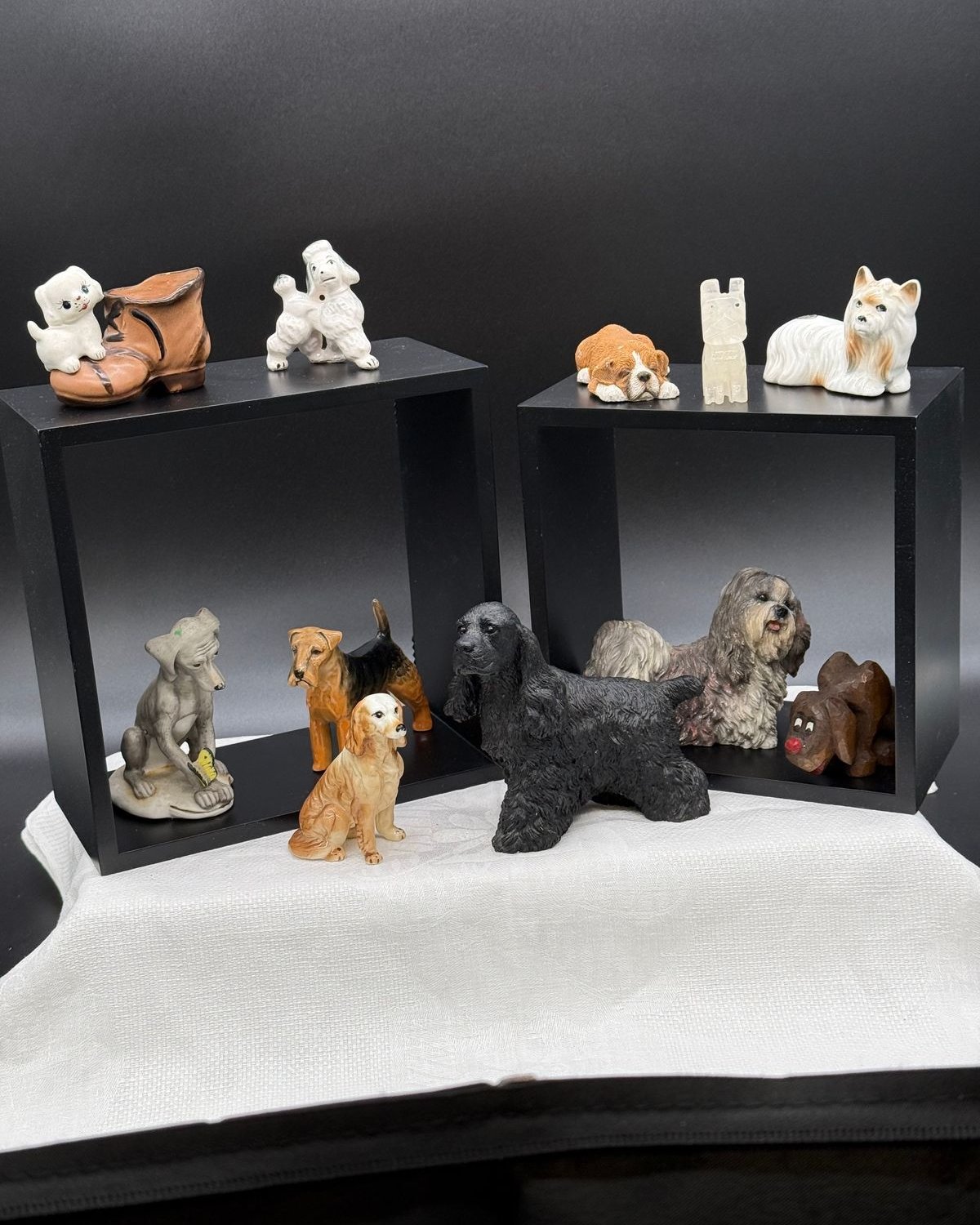
Count them. Eleven dogs came into the shop together, and no two of them were made the same way. One is glazed porcelain with a shine you can see the room in. One is bisque, fired once and left as matte as chalk. One was carved from a block of wood and given a red nose. One is pale stone, cut thin enough at the ears to let the light through.
Bisque is the one worth explaining. It is porcelain that goes through the kiln and then gets left alone: no glaze, no gloss. Skipping the glaze costs the shine but buys back the detail, because glaze pools and rounds off exactly the fine work a modeller spent the day putting in. The grey dog seated on an oval base, with a yellow butterfly landed on one paw, keeps every whisker for that reason.
The glazed pieces made the opposite trade, giving up some crispness for colour and gloss. The white poodle standing on the left box is mid-century through and through; poodles turned up on everything in the 1950s, on skirts and lamps and ashtrays and the sides of drinking glasses. Next to it a puppy hangs off the lip of a brown boot, a novelty planter of the sort that came over from Japan by the crateful after the war and held an ivy cutting on a kitchen windowsill.
Two were modelled from the breed rather than from somebody’s idea of a dog. The black cocker spaniel and the shaggy grey terrier behind it are heavier, cast and then worked over by hand so the coat has direction, and painted in layers so the underneath shows through. Correct ears, correct stance, coat falling the way the real one falls.
The two carved dogs owe nothing to a mould. The small wooden one was cut with a knife and still shows the facets across its back, nose painted red. The pale one is stone, blocky and simply cut, and it lights up if you hold it toward a window.
Come and meet all eleven at Pollyanna’s Antiques in downtown Mt. Clemens. We are open Wednesday, Friday, and Saturday from 10 to 4, and every one of them is small enough that you will want to pick it up.