
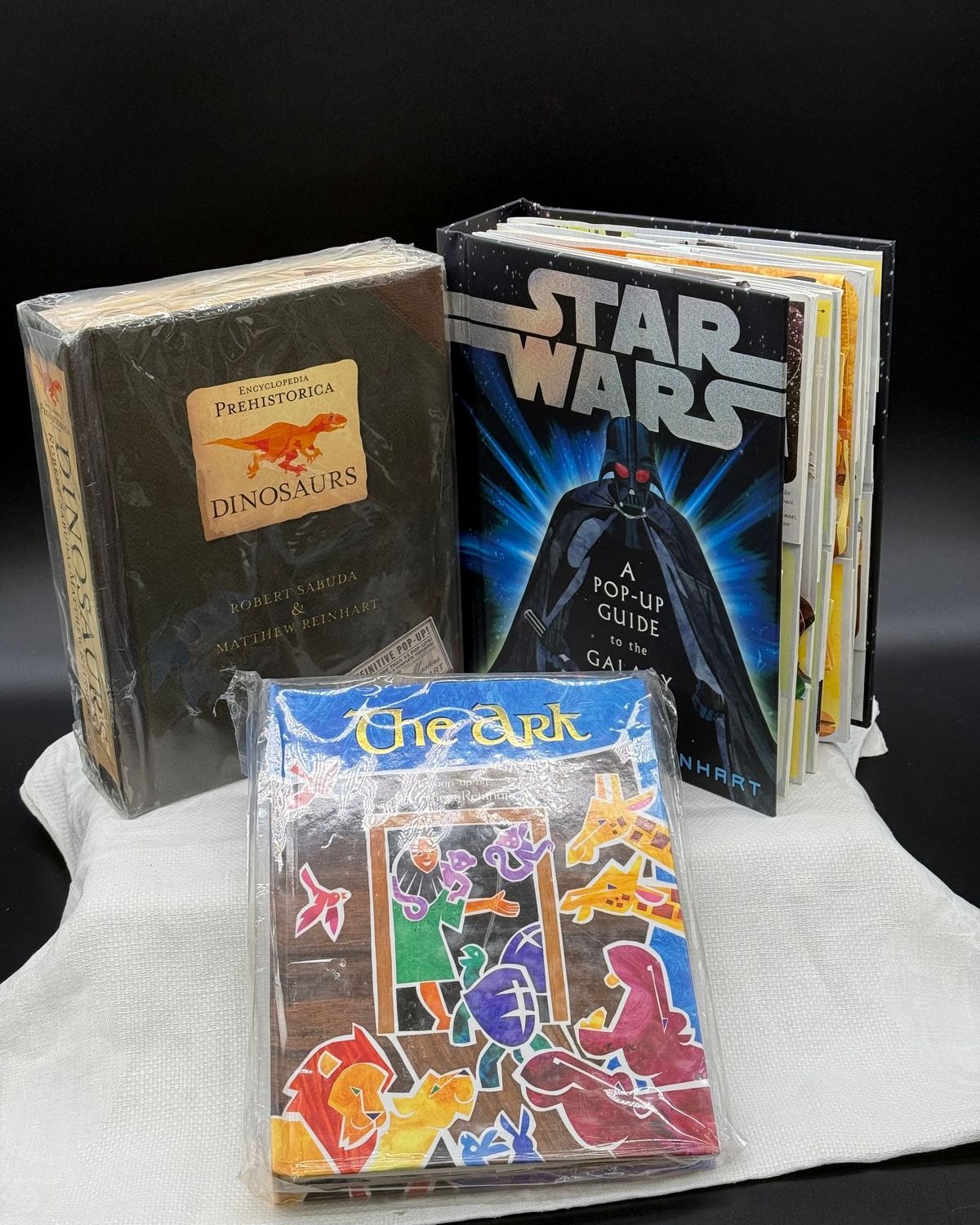
A pop-up book is the only kind of book that has to be engineered. Somebody works out the geometry so a flat sheet folds itself into a shape when the cover swings open, and then somebody else glues it together by hand, one copy at a time. Three of them came into the shop, and all three have the same name on the cover.
That name is Matthew Reinhart, and in this line of work it is about as big as a name gets. The heaviest of the three is Encyclopedia Prehistorica: Dinosaurs, which he made with Robert Sabuda, and the sticker still on the front promises more than thirty-five pop-ups inside. Beside it, standing open so you can see the pages fanned out, is Star Wars: A Pop-Up Guide to the Galaxy. In front sits The Ark, its cover crowded with cut-paper lions and elephants and birds.
The trade word for what Reinhart and Sabuda do is paper engineer, and it is a much older job than it sounds. Books with moving parts turn up as far back as the 1200s, though nobody was making them for children then. The revolving discs and lift-up flaps belonged to astronomers, doctors, and fortune tellers, who used them to work out positions and dates. A London house called Dean and Son was the first to turn the idea into children’s books in quantity, in the 1860s, and a German named Lothar Meggendorfer pushed it furthest a few decades later with levers that set a whole scene moving at once.
What has not changed is the assembly. The sheets come off the press flat, and then people sit at a line and fold and glue every tab by hand. There is no machine that does it. A book with thirty-five pop-ups in it passed through a great many hands before it reached a shelf.
Two of the three are still sealed in their wrappers. The Star Wars is open on the table, which is the better way to meet one anyway. Come and have a look at Pollyanna’s Antiques in downtown Mt. Clemens. We are open Wednesday, Friday, and Saturday from 10 to 4.